
Car Weight
Building a top model solar car means you must to pay attention to ALL areas of its design. There’s little point in doing a really good job in one aspect but then completely ignoring another. It all adds up and you need to consider every little detail if you’re aiming to end up with the fastest possible car.
The last post looked at prism dimensions and model solar car aerodynamics. In this section we’re going to cover another key area that’s just as important or perhaps even more so. Let’s talk car mass (ie weight).
Weight affects all cars in several ways.
- It impacts how long it’s going to take for the car to accelerate/decelerate.
- It influences a vehicle’s rolling resistance.
- It’s distribution and balance can affect car stability and traction.
Engineers must design with these areas in mind while also ensuring an adequate amount of strength and durability. There’s no point in building something that isn’t safe or going to fall apart.
Power to Weight Ratio and Car Acceleration
Racing teams in the F1, V8 Supercars, etc. aim to make their cars as lightweight as the rules, safety requirements and budgets allow. The most obvious benefit of this is to obtain the best possible Power-to-Weight Ratio. In an example where two cars have the same power, the one that is lighter will have a better power to weight ratio ie.

A higher Power-to-Weight Ratio is critical as it means a car can accelerate and decelerate faster than its competition. This gives an advantage at race starts and every time a car enters and exits a track corner. It can really add up in races where there are over 10 corners per lap and cars must complete over 40 laps.
The model solar car race format is a little bit different. The event’s main races are usually held over just a single lap of a 100m figure-8 track. There are only 2 corners and we don’t control the braking/acceleration in/out of them. In bright sunlight the top cars can complete a lap in under 20 seconds so it’s more of a sprint event. For these races you primarily want your car’s Power-to-Weight Ratio to be as high as possible so it can accelerate away from the start gate and reach top speed as quickly as possible.
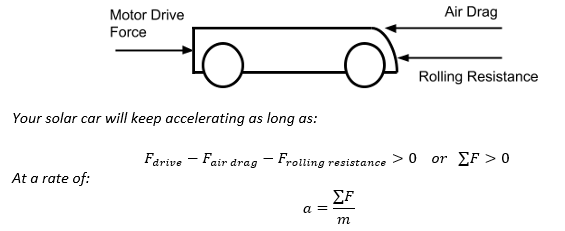
You can look at how acceleration is affected by car weight by considering the following two equations. You may have already come across one or both of these if you’re in high school.

The first of these describes Newton’s Second Law of Motion. If your solar car wheels are providing a set drive force then the car acceleration is going to be inversely proportional to its mass. In other words, the less your car weighs the faster it’s going to accelerate.
Alternatively, you can look at things by taking the above Kinetic Energy (KE) equation into account. At any given speed a heavier car is going to have a higher kinetic energy (Joules). That extra energy needs to come from your solar panel during the race (in Watts or Joules/second) and so it’s going to take longer to reach the same top speed. In other words, the less your car weighs the faster it’s going to accelerate.
Rolling Resistance (Main Wheels)
We briefly touched on a rolling resistance equation in the last post when looking at solar car top speeds:

This equation is actually more generally given by:

But we modified it since the normal force on our level track equates to:

Rolling resistance force is constantly working in the opposite direction to your drive force so you want to keep it as low as possible. You achieve this by minimising both your car mass (ie car weight) and rolling resistance coefficient Crr.
The Crr value will depend on the wheel material and rolling surface. Car tyres rolling over soft sand will have a high coefficient while hard steel train wheels rolling on hard steel rails have a very low coefficient.

Rails lock hard steel train wheels in place to stop them from sliding sideways. Model solar cars have a somewhat similar system but use a guide channel. This means we can use hard and narrow solar car wheels to keep the rolling drag to a minimum (aside from the drive wheel which usually has a thin O-ring tyre for traction).
Conventional road vehicles are unable to make use of such low resistance wheels or they would slide all over the place. They instead need to have wide tyres that provide enough grip for going around corners, taking off from traffic lights, being able to brake fast enough to avoid a collision, etc. F1 and dragster cars have even wider tyres since they need to be capable of gripping onto the track at much higher rates of acceleration/deceleration. Such high-speed cornering and rapid acceleration aren’t as important for solar cars racing in the World Solar Challenge from Darwin to Adelaide and so these use special, thinner, low resistance wheels to minimise their rolling drag.


Road vehicle tyres are designed for variety of weather conditions and road surfaces (above left). F1 tyres are much wider to enable the cars to corner, accelerate, and brake at extreme speeds without losing traction (above centre). Solar car tyres are much narrower and designed to minimise rolling resistance (above right) .
We’ve so far only really considered the straight-line rolling resistance of our solar car. Next, we also need to think about the drag of our rollers that engage with the guide channel.
Rolling Resistance (Guide Rollers)
If your solar car is tracking straight then its rollers will only gently touch the guide rails every now and then while moving in a straight line. This shouldn’t create much additional rolling drag. But what happens when you hit the track corners?
When your solar car enters a bend the inside front and rear rollers are going to press hard up against the guide channel and keep it going around the corner. The resistance of these is given by the same equation above but here the roller Normal force is acting horizontally. We need to use centripetal acceleration ac instead of the acceleration due to gravity.

Where centripetal acceleration is dependent on the square of your car’s velocity and the inverse of the radius of the solar car track corners. In very overcast weather there will be much less rolling resistance than in bright sun when the car is travelling very quickly. From this equation we can see that your car mass will affect the guide roller resistance and the less it weighs the less drag it’s going to have on each corner around the track.
Guide Roller Mounting Strength
If you’re looking to modify a solar car kit or building your own from scratch then you must think carefully about how to mount your guide rollers. You can’t just attach them to a thin sheet of balsa wood and expect it to last for the duration of a competition. These mounting points will likely need to be stronger than your main wheels. As a quick example, our smaller circular pursuit race track has a corner radius of 3.5m so you only need to be travelling at 5.9m/s or faster for the force on your 2 inner guide rollers to exceed the force spread over your main 3 or 4 wheels due to gravity.
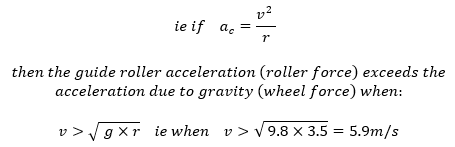
Top cars will easily reach top speeds of over 5.9m/s in bright sunshine so do not underestimate the stress your guide rollers are going to be put under when cornering.
Traction and Weight Distribution
Any rubber tyre on your wheels will increase rolling resistance. This is due to the energy loss from tyre deformation and an increase in contact friction. As a rubber tyre rolls, it compresses and flattens under the weight of your solar car and then rebounds back into its original shape as it leaves the track surface. This creates a small amount of heat and loss of energy.
It’s due to these losses we try to use rigid, hard rimmed solar car wheels on our hard plywood track.
Hard slippery wheels are great for minimising your rolling resistance but leave you hardly any traction on the track for your drive wheel/s. It’s for this reason that most teams use a very thin O-ring on their drive wheel. This gives just enough grip to avoid excessive wheel slip while keeping your rolling drag to a minimum. At lower sun levels it may even be possible to run without a tyre altogether since there’s going to be less drive torque and you no longer need as much traction to get your solar car moving.
Just a quick word on how you distribute the weight around your solar car. If you place the solar panel and ballast heavily to one side or end but have the drive wheel at the other then you’re going to increase the risk of losing drive traction. You should instead be aiming for the car weight to be distributed evenly across all your wheels for best overall balance or, if anything, have a bit of extra load directed towards the drive wheel.
Car Stability
The faster your model solar car gets the harder it will be to keep it on the track. The main factors that will influence how well your car stays on the track include:
- Centre of Gravity
- Track width (ie how wide the wheels on your axles are spaced apart)
- Guide roller height
- Car Flex/Suspension (ie how well it absorbs track misalignments)
You can look at how your centre of gravity and track width are going to affect roll over stability by considering the following force diagram:
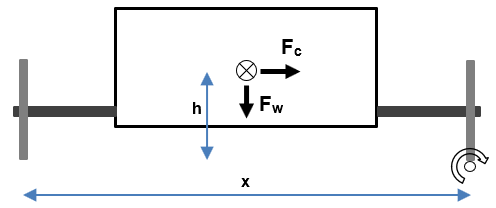
If we assume the pivot point is where the outer wheels make contact with the track then we hit rollover velocity when:

By cancelling out the mass and rearranging we end up with the following equation:
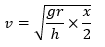
For a model solar car with its wheels at near full width (say 300mm apart), a CoG at 50mm above the track and 5m figure-8 corner radius this gives us a rollover speed of:
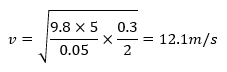
Top solar cars generally top out at around 7-8m/s so this leaves some pretty good margin for error. But what happens if you were to cut your axles so the wheels aren’t as wide (say only 200mm apart) and you build a really high car with all the solar panel weight right at the top (now making the CoG 100mm above the track):
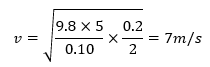
This is right on the limit and any slight bump will send your car flying off the track. This rollover speed will be even less on our circular race track with a corner radius or only 3.5m
If you want to minimise your chance of rolling over then you need to keep your axles as wide as possible and your CoG as low as possible.
Guide Roller Height
Don’t forget to keep your guide rollers as low as possible. Our guide channel is only 13-16mm high so the rollers don’t have much of a safety margin. Any small misalignments in the track or bumps can easily derail your car if the rollers aren’t set low enough. You should be aiming for approximately 2-3mm between the bottom of the rollers and the track. Less than this is risky since you might start to scrape them on parts of the track or catch a track misalignment. If you go more than 3-4mm then you’ll increase your chances of coming off the track.
Car Flex/Suspension
A quick word on car flex and suspension. This is perhaps something least looked at when designing a model solar car and often comes down to a bit of luck. Some cars just seem to end up having a better ability to negotiate track bumps and misalignments than others. Their stiffness throughout has them land right in the sweet spot between being too rigid to absorb hits with minimal impact or having far too much flex/suspension to bounce or twist in an unfavourable way.
There have been cases in the past where car bounce has reached a form of resonance and caused the car to jump off the track. This happens when track misalignments or a small bow in a string of consecutive track sections start causing a car to bounce up and down. You can think of this a bit like pushing someone on a playground swing. The swing has a natural frequency of swinging back and forth and only needs a small push at the right time to either go higher and higher or maintain its level. For a bit more of a look at destructive resonance you may like to check out the following video:
www.youtube.com/watch?v=qkQV-CXWZCU
Looking at the Overall Impact of Car Weight on Race Times
In the last post we used an Excel-based model solar car simulator to see what kind of a difference car aerodynamics can make over a 1 lap race. We can also use the simulator to look at the impact of various car weights. If you missed it, you can download it from the TMSC kits page here:
www.tassolarchallenge.org/tmsc-kits/
The simulator has a drop-down selection box where you can choose a car weight ranging from 250g (ultra-lightweight) all the way up to 600g (very heavy). These weights are of your car minus the required solar panel weight and also does not include the weight of your electronics controller (this is approx. 50g and already added in the simulator if you select an electronics unit like the Automax or Picaxe 08M2 from the drop-down menu).
A 250g car is getting seriously light. 300g would be more typical of the lightest cars so let’s go with that in this example. 600g is very heavy but not completely uncommon. If you compare their race times across a few different sun levels you’ll loosely have the 300g car being quicker by the following margins:
100% sun: >1.5s
55% sun: >2.0s
29% sun: >3.0s
15% sun: >7.0s
Now imagine combining this 1.5s with the 2.0s difference we saw in the aerodynamics section at 100% sun. That’s a 3.5 difference between a lightweight car with a low air drag coefficient verses a heavy one with poor streamlining. If the cars are travelling at close to 7m/s by the end of the race then this translates to a 3.5 x 7 = 24.5m gap between the two at the finish. That’s just about the entire length of one of the straights on the figure-8 track!
Aerodynamics and car mass (ie weight) are two of the most fundamental areas you need to be focusing on if you’re hoping to build a fast car. This is a STEM competition after all and, no, model solar cars aren’t exempt from the laws of physics. All your design choices should be made with these laws kept at the forefront in your mind.